The Three S’s of Being: Swayambhu, Skandhas, and Śūnyatā in Ambedkar’s Deconstruction of Caste-Self
Article Sidebar
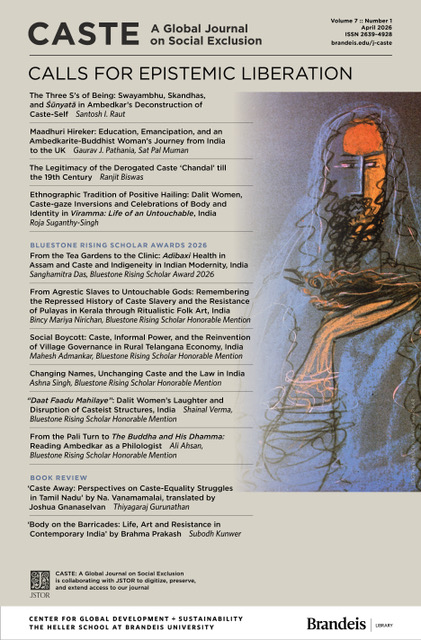
Main Article Content
Abstract
This article examines how B.R. Ambedkar deployed three interconnected Buddhist philosophical categories—swayambhu (self-becoming), skandha (aggregates), and anattā (selflessness)—to construct a systematic critique of caste as simultaneously a metaphysical, social, and epistemological formation. While Ambedkar’s political and constitutional contributions are well studied, his philosophical engagement with Buddhist doctrine as a tool for dismantling caste ontology has received comparatively less rigorous analysis, and the epistemological dimension of his critique has been largely overlooked. This article addresses that gap by reading Ambedkar’s writings, particularly The Buddha and His Dhamma (1957), Annihilation of Caste (1936), and Revolution and Counter-Revolution in Ancient India, alongside the Pali canonical doctrine of Dependent Origination (paṭiccasamuppāda), Aśvaghoṣa’s Vajrasūcī, and the classical analysis of the five aggregates. The central argument is that Ambedkar identified a structural homology between the Brahmanical doctrine of an eternal, self-existent self (ātman/swayambhu) and the ideological foundation of caste: both posit fixed, inherent essences where Buddhist analysis reveals only conditioned processes. Crucially, this article introduces three interrelated concepts—epistemic enclosure, epistemic caste, and epistemocide—to name the mechanisms by which the caste system functions not only as a social hierarchy but as a knowledge hierarchy, one that denies Śūdras, untouchables, and women the very status of knowers. By systematically applying the Buddhist teaching that phenomena lack inherent self-nature (svabhāva), Ambedkar reframed caste not as a natural or divinely ordained category but as a contingent mental construction sustained by wrong view (micchā-diṭṭhi). Ambedkar’s reading of the Bhagavad Gita as a “philosophic defence of counter-revolution” is shown to be integral to his deconstruction: the Gita’s attempt to ground caturvarṇa in the theory of innate qualities (guṇas) represents, in Buddhist terms, a paradigmatic instance of wrong view (pāpa-diṭṭhikaṃ)—the reification of contingent social categories into fixed ontological essences. The article traces how this philosophical deconstruction informed Ambedkar’s practical programme of conversion, culminating in the Navayāna movement and the twenty-two vows of 1956, and argues that the Navayāna denomination constitutes an act of epistemic liberation: the reclamation by formerly excluded communities of the right to know, to interpret, and to construct meaning.
Downloads
Article Details

This work is licensed under a Creative Commons Attribution 4.0 International License.
A. CORRESPONDING AUTHOR’S GRANT OF RIGHTS
The Corresponding Author grants to the Journal, during the full term of copyright and any extensions or renewals of that term, the following:
- An irrevocable non-exclusive right to reproduce, republish, transmit, sell, distribute, and otherwise use the Work in electronic and print editions of the Journal and in derivative works throughout the world, in all languages, and in all media now known or later developed.
- An irrevocable non-exclusive right to create and store electronic archival copies of the Work, including the right to deposit the Work in open access digital repositories.
- An irrevocable non-exclusive right to license others to reproduce, republish, transmit, and distribute the Work under the condition that the Authors are attributed. (Currently this is carried out by publishing the content under a Creative Commons Attribution 4.0 license.)
Copyright in the Work remains with the Authors.
B. CORRESPONDING AUTHOR’S DUTIES
- When distributing or re-publishing the Work, the Corresponding Author agrees to credit the Journal as the place of first publication.
- The Corresponding Author agrees to inform the Journal of any changes in contact information.
C. CORRESPONDING AUTHOR’S WARRANTY
The Corresponding Author represents and warrants that the Work is the Authors’ original work and that it does not violate or infringe the law or the rights of any third party and, specifically, that the Work contains no matter that is defamatory or that infringes any literary or proprietary rights, intellectual property rights, or any rights of privacy. The Corresponding Author also warrants that he or she has the full power to make this agreement, and if the Work was prepared jointly, the Corresponding Author agrees to inform the Authors of the terms of this Agreement and to obtain their written permission to sign on their behalf. The Corresponding Author agrees to hold the Journal harmless from any breach of the aforestated representations.
D. JOURNAL’S DUTIES
In consideration of the Author’s grant of rights, the Journal agrees to publish the Work, attributing the Work to the Authors.
E. ENTIRE AGREEMENT
This agreement reflects the entire understanding of the parties. This agreement may be amended only in writing by an addendum signed by the parties. Amendments are incorporated by reference to this agreement.