Maadhuri Hireker: Education, Emancipation, and an Ambedkarite-Buddhist Woman’s Journey from India to the UK
Article Sidebar
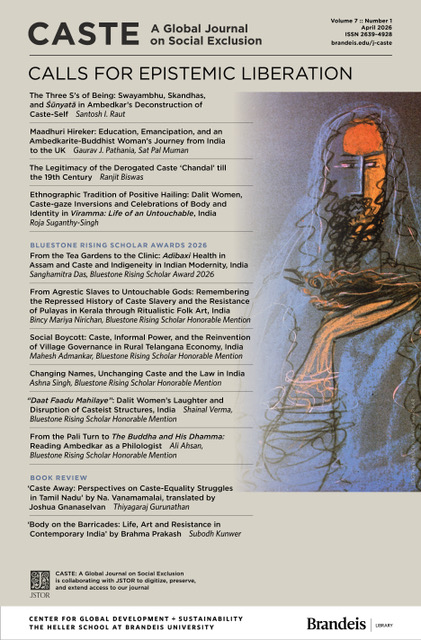
Main Article Content
Abstract
This article presents a transnational oral history of Maadhuri Hireker (b. 1940), a first-generation educated Ambedkarite woman whose life traverses rural Maharashtra, the historic moment of Buddhist conversion in 1956, and the institutionalization of Ambedkarism in postwar Britain. Grounded in extended first-person narrative, it advances an Ambedkarite feminist methodology that treats lived experience as a site of theory production rather than illustrative data. It argues that Ambedkarism circulates not as abstract ideology but as an ethical and socio-political practice, enacted through education, refusal of humiliation, gendered agency, and institution-building across borders.
Situating Maadhuri’s life within Ambedkar’s core commitments—the annihilation of caste, education as emancipation, ethical self-respect, and resistance to graded inequality—the article foregrounds the gendered labour through which Ambedkarite ethics are sustained and transmitted in the diaspora. Placing her experiences alongside Ambedkar’s writings and subsequent scholarship, it shows how her life challenges patriarchy, caste, and untouchability while extending Ambedkarite thought in practice. Rooted in rural Maharashtra, Maadhuri drew on a distinct cultural and political inheritance, including witnessing Dr. Ambedkar firsthand, which shaped her trajectory toward emancipation. By centering her voice, the article addresses a significant gap in scholarship on Dalit women’s leadership within the global Ambedkarite movement while also contributing to broader discussions on caste, feminism, oral history, and migration. The article is embedded in a longitudinal project documenting the oral histories of first-generation Ambedkarites who migrated to the UK between the 1950s and 1970s and laid the foundations of contemporary Ambedkarism.
Downloads
Article Details

This work is licensed under a Creative Commons Attribution 4.0 International License.
A. CORRESPONDING AUTHOR’S GRANT OF RIGHTS
The Corresponding Author grants to the Journal, during the full term of copyright and any extensions or renewals of that term, the following:
- An irrevocable non-exclusive right to reproduce, republish, transmit, sell, distribute, and otherwise use the Work in electronic and print editions of the Journal and in derivative works throughout the world, in all languages, and in all media now known or later developed.
- An irrevocable non-exclusive right to create and store electronic archival copies of the Work, including the right to deposit the Work in open access digital repositories.
- An irrevocable non-exclusive right to license others to reproduce, republish, transmit, and distribute the Work under the condition that the Authors are attributed. (Currently this is carried out by publishing the content under a Creative Commons Attribution 4.0 license.)
Copyright in the Work remains with the Authors.
B. CORRESPONDING AUTHOR’S DUTIES
- When distributing or re-publishing the Work, the Corresponding Author agrees to credit the Journal as the place of first publication.
- The Corresponding Author agrees to inform the Journal of any changes in contact information.
C. CORRESPONDING AUTHOR’S WARRANTY
The Corresponding Author represents and warrants that the Work is the Authors’ original work and that it does not violate or infringe the law or the rights of any third party and, specifically, that the Work contains no matter that is defamatory or that infringes any literary or proprietary rights, intellectual property rights, or any rights of privacy. The Corresponding Author also warrants that he or she has the full power to make this agreement, and if the Work was prepared jointly, the Corresponding Author agrees to inform the Authors of the terms of this Agreement and to obtain their written permission to sign on their behalf. The Corresponding Author agrees to hold the Journal harmless from any breach of the aforestated representations.
D. JOURNAL’S DUTIES
In consideration of the Author’s grant of rights, the Journal agrees to publish the Work, attributing the Work to the Authors.
E. ENTIRE AGREEMENT
This agreement reflects the entire understanding of the parties. This agreement may be amended only in writing by an addendum signed by the parties. Amendments are incorporated by reference to this agreement.