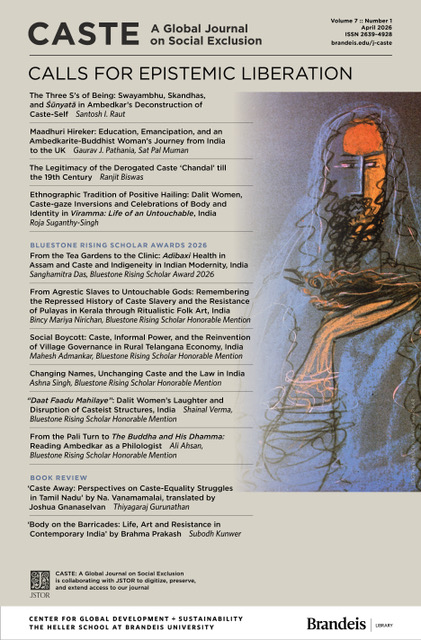
From the Tea Gardens to the Clinic: Adibaxi Health in Assam and Caste and Indigeneity in Indian Modernity, India Bluestone Rising Scholar Award 2026
Article Sidebar
Main Article Content
Abstract
The tea plantations of Assam, remnants of the British Raj in postcolonial India, comprise an important epistemic site for interrogating transformations in the ancient caste system within Indian modernity. Two theoretical interventions become possible through a social inquiry that begins in the plantations of North-East India. First, refuting the alleged “castelessness” of Hindu majoritarian societies like Assam in North-East India, the article discusses how articulations of Indigeneity in India are inflected by the caste-system. Second, it demonstrates the embeddedness of caste-based human differentiation within a central node of postcolonial development—the clinic. Analyzing caste as a trenchant ordering principle in India, in this article, I argue that practices and experiences of caste-based human differentiation have transformed in postcolonial India. The article describes how caste inhabits India’s postcolonial medical institutions in a new scientized garb, bolstering overt casteizing practices with a euphemistic discourse of bio-behavioral deviance. I demonstrate how the Indigenous Adivasis, specifically the tea plantation laborers of Assam colloquially termed as the Adibaxis, became the object of caste-based socio-biological differentiation both within the plantation and in public health institutions. One of the main conditions of life in the tea plantations of Assam is inadequate medical care. Taking health and healthcare infrastructures as sites of anthropological and critical caste inquiry, I describe how caste-based dispossession is reinscribed onto the bodies of Adibaxi tea plantation workers through persistent medical exclusions.
Downloads
Article Details

This work is licensed under a Creative Commons Attribution 4.0 International License.
A. CORRESPONDING AUTHOR’S GRANT OF RIGHTS
The Corresponding Author grants to the Journal, during the full term of copyright and any extensions or renewals of that term, the following:
- An irrevocable non-exclusive right to reproduce, republish, transmit, sell, distribute, and otherwise use the Work in electronic and print editions of the Journal and in derivative works throughout the world, in all languages, and in all media now known or later developed.
- An irrevocable non-exclusive right to create and store electronic archival copies of the Work, including the right to deposit the Work in open access digital repositories.
- An irrevocable non-exclusive right to license others to reproduce, republish, transmit, and distribute the Work under the condition that the Authors are attributed. (Currently this is carried out by publishing the content under a Creative Commons Attribution 4.0 license.)
Copyright in the Work remains with the Authors.
B. CORRESPONDING AUTHOR’S DUTIES
- When distributing or re-publishing the Work, the Corresponding Author agrees to credit the Journal as the place of first publication.
- The Corresponding Author agrees to inform the Journal of any changes in contact information.
C. CORRESPONDING AUTHOR’S WARRANTY
The Corresponding Author represents and warrants that the Work is the Authors’ original work and that it does not violate or infringe the law or the rights of any third party and, specifically, that the Work contains no matter that is defamatory or that infringes any literary or proprietary rights, intellectual property rights, or any rights of privacy. The Corresponding Author also warrants that he or she has the full power to make this agreement, and if the Work was prepared jointly, the Corresponding Author agrees to inform the Authors of the terms of this Agreement and to obtain their written permission to sign on their behalf. The Corresponding Author agrees to hold the Journal harmless from any breach of the aforestated representations.
D. JOURNAL’S DUTIES
In consideration of the Author’s grant of rights, the Journal agrees to publish the Work, attributing the Work to the Authors.
E. ENTIRE AGREEMENT
This agreement reflects the entire understanding of the parties. This agreement may be amended only in writing by an addendum signed by the parties. Amendments are incorporated by reference to this agreement.