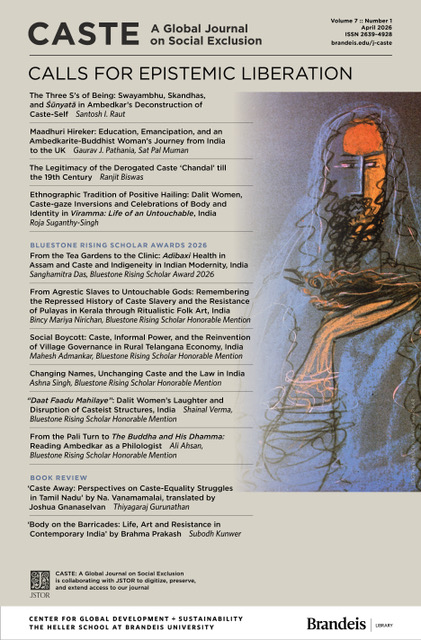
Changing Names, Unchanging Caste and the Law in India Bluestone Rising Scholar Honorable Mention
Article Sidebar
Main Article Content
Abstract
In recent times, several claims have been made before Indian courts to seek the change of one’s first name or surname. Such claims are being made for many different reasons out of which one reason stands out which is to hide one’s caste identity, namely to hide one’s untouchable or Dalit identity. While much has been written about concealing caste in autobiographical literature, and socio-political theories have engaged with the question of identity and recognition, the legal framework governing these practices remains under- examined. The Indian courts have interpreted the right to change one’s name as an aspect of the right to determine one’s identity or the right of self-determination, drawing from existing constitutional law principles and jurisprudence. This jurisprudence on the right to determine one’s identity has evolved through constitutional questions on gender identity, sexual expression, and privacy. However, in this article, I argue that the liberal interpretation of the right to change one’s name as framed through the prism of the individual right to identity under-assumes the pervasive and structural nature of caste and consequentially severely undermines the metric of dignity. I argue that in effect, the judicial recognition of the right to alter one’s name amounts to endorsing a limited right to conceal caste or the right to pass rather than facilitating a genuine right to assert or change one’s caste identity.
Downloads
Article Details

This work is licensed under a Creative Commons Attribution 4.0 International License.
A. CORRESPONDING AUTHOR’S GRANT OF RIGHTS
The Corresponding Author grants to the Journal, during the full term of copyright and any extensions or renewals of that term, the following:
- An irrevocable non-exclusive right to reproduce, republish, transmit, sell, distribute, and otherwise use the Work in electronic and print editions of the Journal and in derivative works throughout the world, in all languages, and in all media now known or later developed.
- An irrevocable non-exclusive right to create and store electronic archival copies of the Work, including the right to deposit the Work in open access digital repositories.
- An irrevocable non-exclusive right to license others to reproduce, republish, transmit, and distribute the Work under the condition that the Authors are attributed. (Currently this is carried out by publishing the content under a Creative Commons Attribution 4.0 license.)
Copyright in the Work remains with the Authors.
B. CORRESPONDING AUTHOR’S DUTIES
- When distributing or re-publishing the Work, the Corresponding Author agrees to credit the Journal as the place of first publication.
- The Corresponding Author agrees to inform the Journal of any changes in contact information.
C. CORRESPONDING AUTHOR’S WARRANTY
The Corresponding Author represents and warrants that the Work is the Authors’ original work and that it does not violate or infringe the law or the rights of any third party and, specifically, that the Work contains no matter that is defamatory or that infringes any literary or proprietary rights, intellectual property rights, or any rights of privacy. The Corresponding Author also warrants that he or she has the full power to make this agreement, and if the Work was prepared jointly, the Corresponding Author agrees to inform the Authors of the terms of this Agreement and to obtain their written permission to sign on their behalf. The Corresponding Author agrees to hold the Journal harmless from any breach of the aforestated representations.
D. JOURNAL’S DUTIES
In consideration of the Author’s grant of rights, the Journal agrees to publish the Work, attributing the Work to the Authors.
E. ENTIRE AGREEMENT
This agreement reflects the entire understanding of the parties. This agreement may be amended only in writing by an addendum signed by the parties. Amendments are incorporated by reference to this agreement.