Social Boycott: Caste, Informal Power, and the Reinvention of Village Governance in Rural Telangana Economy, India Bluestone Rising Scholar Honorable Mention
Article Sidebar
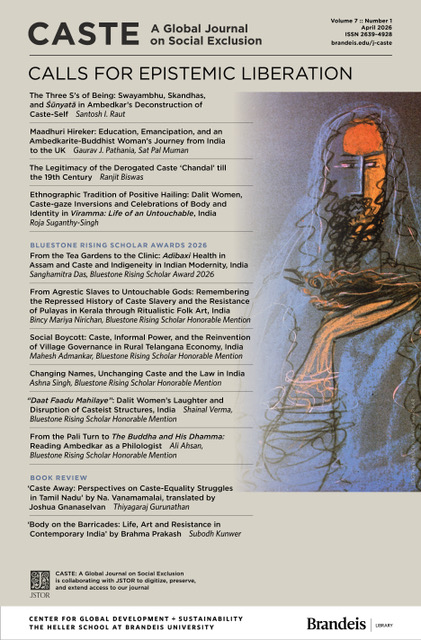
Main Article Content
Abstract
This article examines social boycott as a contemporary form of caste power in rural Telangana society and economy, focusing on the role of Village Development Committees (VDCs) originating from the informal caste councils. Drawing on qualitative interviews with 20 respondents (8 women and 12 men; 8 from Scheduled Castes and 12 from Other Backward Classes) and autoethnographic reflections, the study reveals how social boycott operates through economic exclusion, control of commons, religious coercion, and gendered surveillance. The article argues that social boycott represents a form of informal sovereignty that thrives in the gap between constitutional law and everyday governance. By situating boycott within broader debates on decentralization, caste capture, and rural democracy, the study highlights the limitations of existing legal frameworks and the failure of state institutions to protect marginalized communities. The article concludes by proposing sociologically-grounded policy interventions aimed at criminalizing social boycott, regulating informal caste bodies, protecting livelihoods, and re-democratizing village governance.
Downloads
Article Details

This work is licensed under a Creative Commons Attribution 4.0 International License.
A. CORRESPONDING AUTHOR’S GRANT OF RIGHTS
The Corresponding Author grants to the Journal, during the full term of copyright and any extensions or renewals of that term, the following:
- An irrevocable non-exclusive right to reproduce, republish, transmit, sell, distribute, and otherwise use the Work in electronic and print editions of the Journal and in derivative works throughout the world, in all languages, and in all media now known or later developed.
- An irrevocable non-exclusive right to create and store electronic archival copies of the Work, including the right to deposit the Work in open access digital repositories.
- An irrevocable non-exclusive right to license others to reproduce, republish, transmit, and distribute the Work under the condition that the Authors are attributed. (Currently this is carried out by publishing the content under a Creative Commons Attribution 4.0 license.)
Copyright in the Work remains with the Authors.
B. CORRESPONDING AUTHOR’S DUTIES
- When distributing or re-publishing the Work, the Corresponding Author agrees to credit the Journal as the place of first publication.
- The Corresponding Author agrees to inform the Journal of any changes in contact information.
C. CORRESPONDING AUTHOR’S WARRANTY
The Corresponding Author represents and warrants that the Work is the Authors’ original work and that it does not violate or infringe the law or the rights of any third party and, specifically, that the Work contains no matter that is defamatory or that infringes any literary or proprietary rights, intellectual property rights, or any rights of privacy. The Corresponding Author also warrants that he or she has the full power to make this agreement, and if the Work was prepared jointly, the Corresponding Author agrees to inform the Authors of the terms of this Agreement and to obtain their written permission to sign on their behalf. The Corresponding Author agrees to hold the Journal harmless from any breach of the aforestated representations.
D. JOURNAL’S DUTIES
In consideration of the Author’s grant of rights, the Journal agrees to publish the Work, attributing the Work to the Authors.
E. ENTIRE AGREEMENT
This agreement reflects the entire understanding of the parties. This agreement may be amended only in writing by an addendum signed by the parties. Amendments are incorporated by reference to this agreement.