“Daat Faadu Mahilaye”: Dalit Women’s Laughter and Disruption of Casteist Structures, India Bluestone Rising Scholar Honorable Mention
Article Sidebar
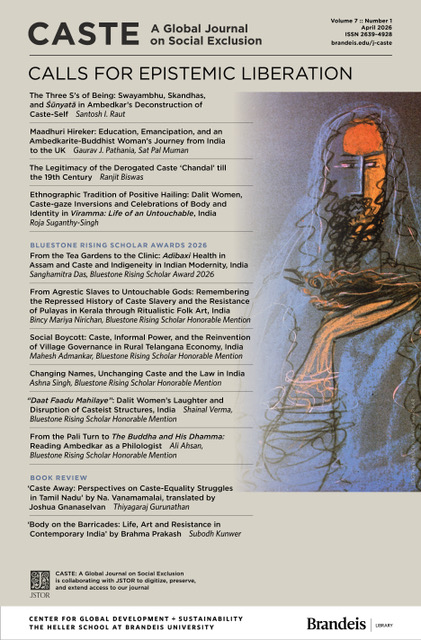
Main Article Content
Abstract
Drawing from ethnographic fieldwork conducted from 2022 to 2024 in two urban villages in Delhi, I investigate how Dalit women’s laughter functions as a powerful site of anti-caste resistance and feminist praxis. Moving away from dominant frameworks that foreground grief and victimhood, I centre laughter as an everyday embodied tactic employed by Dalit women to navigate and subvert the structural violences of caste, gender, class, and religion. I analyse how laughter operates as a generative force—simultaneously affective and political— and thus unsettles the fixity of caste, gender, class, space and religion. Engaging with interdisciplinary debates in feminist anthropology, Dalit studies, and humour theory, I examine how Dalit women’s shared, rebellious, and often vulgar laughter forms a counter-public, subaltern speech act that challenges brahminical patriarchy. Laughter, conventionally perceived as an expression of joy, I argue, is a defense mechanism employed by Dalit women to navigate everyday caste violence in the cities, creating the societal perception of them as Daat Faadu Mahilaye (Women Who Show Teeth). This analysis is crucial, as caste significantly influences women’s access to laughter in India. I ask, who has the privilege to laugh? Whose right to laughter is jeopardized? Who are the women who laugh more frequently, and why? This paper offers insights into discussions of gender, and urban marginalization.
Downloads
Article Details

This work is licensed under a Creative Commons Attribution 4.0 International License.
A. CORRESPONDING AUTHOR’S GRANT OF RIGHTS
The Corresponding Author grants to the Journal, during the full term of copyright and any extensions or renewals of that term, the following:
- An irrevocable non-exclusive right to reproduce, republish, transmit, sell, distribute, and otherwise use the Work in electronic and print editions of the Journal and in derivative works throughout the world, in all languages, and in all media now known or later developed.
- An irrevocable non-exclusive right to create and store electronic archival copies of the Work, including the right to deposit the Work in open access digital repositories.
- An irrevocable non-exclusive right to license others to reproduce, republish, transmit, and distribute the Work under the condition that the Authors are attributed. (Currently this is carried out by publishing the content under a Creative Commons Attribution 4.0 license.)
Copyright in the Work remains with the Authors.
B. CORRESPONDING AUTHOR’S DUTIES
- When distributing or re-publishing the Work, the Corresponding Author agrees to credit the Journal as the place of first publication.
- The Corresponding Author agrees to inform the Journal of any changes in contact information.
C. CORRESPONDING AUTHOR’S WARRANTY
The Corresponding Author represents and warrants that the Work is the Authors’ original work and that it does not violate or infringe the law or the rights of any third party and, specifically, that the Work contains no matter that is defamatory or that infringes any literary or proprietary rights, intellectual property rights, or any rights of privacy. The Corresponding Author also warrants that he or she has the full power to make this agreement, and if the Work was prepared jointly, the Corresponding Author agrees to inform the Authors of the terms of this Agreement and to obtain their written permission to sign on their behalf. The Corresponding Author agrees to hold the Journal harmless from any breach of the aforestated representations.
D. JOURNAL’S DUTIES
In consideration of the Author’s grant of rights, the Journal agrees to publish the Work, attributing the Work to the Authors.
E. ENTIRE AGREEMENT
This agreement reflects the entire understanding of the parties. This agreement may be amended only in writing by an addendum signed by the parties. Amendments are incorporated by reference to this agreement.