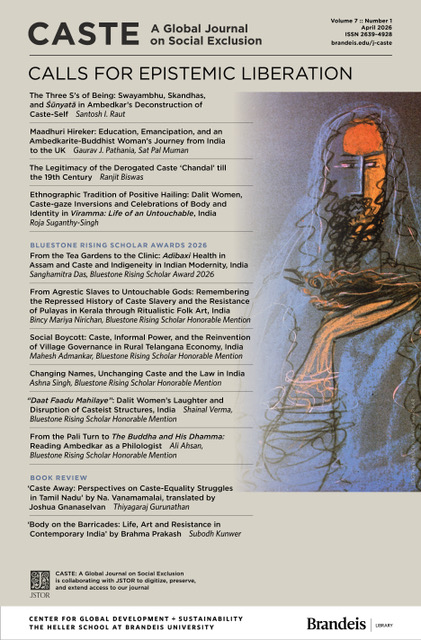
From the Pali Turn to The Buddha and His Dhamma: Reading Ambedkar as a Philologist Bluestone Rising Scholar Honorable Mention
Article Sidebar
Main Article Content
Abstract
This article reconstructs B.R. Ambedkar as a philologist by engaging with three different strands of his scholarship. First, it traces his work on language in general and his construction of Pali as a language emblematic of Buddhism. By following cues in Ambedkar’s own writings and historicizing it, the article in its second section close reads the major historical stakes of his work. These two strands focus on how liturgical languages engage with caste hierarchy, and how ancient Indian history is perceived anew through Ambedkar’s critique of Brahmanism alongside contemporary scholarship on history. This long historical thread culminates in The Buddha and His Dhamma along with the focus on religion within his writings, which forms the third section of the article. I propose that the three strands together complete the trajectory of Ambedkar’s philological project for which he lays a critical foundation through an overarching history of India and its linguistic and religious past. In the article, the object of analysis is caste as a non-static category and how it functions from antiquity to the mid-twentieth century. Ultimately, I argue that Ambedkar reformulates the idea of what it means to be sacred from a Navayana Buddhist point of view, symbolized through a move away from Hinduism, which he announced at the Yeola conference in 1935, to the moment of his conversion to Buddhism in 1956.
Downloads
Article Details

This work is licensed under a Creative Commons Attribution 4.0 International License.
A. CORRESPONDING AUTHOR’S GRANT OF RIGHTS
The Corresponding Author grants to the Journal, during the full term of copyright and any extensions or renewals of that term, the following:
- An irrevocable non-exclusive right to reproduce, republish, transmit, sell, distribute, and otherwise use the Work in electronic and print editions of the Journal and in derivative works throughout the world, in all languages, and in all media now known or later developed.
- An irrevocable non-exclusive right to create and store electronic archival copies of the Work, including the right to deposit the Work in open access digital repositories.
- An irrevocable non-exclusive right to license others to reproduce, republish, transmit, and distribute the Work under the condition that the Authors are attributed. (Currently this is carried out by publishing the content under a Creative Commons Attribution 4.0 license.)
Copyright in the Work remains with the Authors.
B. CORRESPONDING AUTHOR’S DUTIES
- When distributing or re-publishing the Work, the Corresponding Author agrees to credit the Journal as the place of first publication.
- The Corresponding Author agrees to inform the Journal of any changes in contact information.
C. CORRESPONDING AUTHOR’S WARRANTY
The Corresponding Author represents and warrants that the Work is the Authors’ original work and that it does not violate or infringe the law or the rights of any third party and, specifically, that the Work contains no matter that is defamatory or that infringes any literary or proprietary rights, intellectual property rights, or any rights of privacy. The Corresponding Author also warrants that he or she has the full power to make this agreement, and if the Work was prepared jointly, the Corresponding Author agrees to inform the Authors of the terms of this Agreement and to obtain their written permission to sign on their behalf. The Corresponding Author agrees to hold the Journal harmless from any breach of the aforestated representations.
D. JOURNAL’S DUTIES
In consideration of the Author’s grant of rights, the Journal agrees to publish the Work, attributing the Work to the Authors.
E. ENTIRE AGREEMENT
This agreement reflects the entire understanding of the parties. This agreement may be amended only in writing by an addendum signed by the parties. Amendments are incorporated by reference to this agreement.