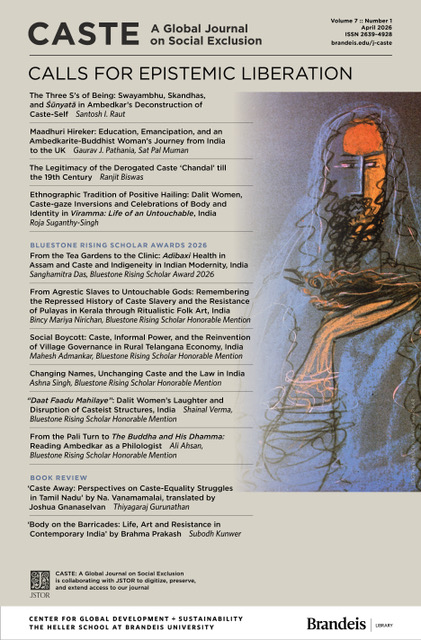
From Agrestic Slaves to Untouchable Gods: Remembering the Repressed History of Caste Slavery and the Resistance of Pulayas in Kerala through Ritualistic Folk Art, India Bluestone Rising Scholar Honorable Mention
Article Sidebar
Main Article Content
Abstract
The empirical ordering of the upper castes through scriptural doctrines delegitimized the subaltern epistemology and impeded the possibility of any form of resistance. The article finds relevance in delving deep into the subversive acts of the most marginalized against Brahmanised hegemonic discourse and examines how they developed it as an epistemology of resistance. It particularly makes an in-depth inquiry into the past of Pulaya, a Dalit community in North Malabar, Kerala, and their history of resistance through a ritualistic folk art, Mari Theyyam. By closely examining the performance, paraphernalia and rituals associated with Mari Theyyam, this article emphasises that Mari Theyyam functions as a living archive and a counter-hegemonic epistemology sustained by the most marginalised community to challenge the erased or repressed history of caste slavery. The spatial mapping of Mari Theyyam also holds significance as it provides critical insight into the deeply entrenched caste system and the prevailing caste dynamics in Kerala. The article argues that, in a dark epoch that made Dalits voiceless and prevented them from raising their voice and writing culture, Pulayas of North Malabar made use of their folklore to collate their shared memories and oral testimonies of caste slavery. By conceptualizing Mari Theyyam as an alternative epistemology, the article contributes to Dalit studies and aesthetics, subaltern studies, religious studies, inequality studies and performance studies of South Asia.
Downloads
Article Details

This work is licensed under a Creative Commons Attribution 4.0 International License.
A. CORRESPONDING AUTHOR’S GRANT OF RIGHTS
The Corresponding Author grants to the Journal, during the full term of copyright and any extensions or renewals of that term, the following:
- An irrevocable non-exclusive right to reproduce, republish, transmit, sell, distribute, and otherwise use the Work in electronic and print editions of the Journal and in derivative works throughout the world, in all languages, and in all media now known or later developed.
- An irrevocable non-exclusive right to create and store electronic archival copies of the Work, including the right to deposit the Work in open access digital repositories.
- An irrevocable non-exclusive right to license others to reproduce, republish, transmit, and distribute the Work under the condition that the Authors are attributed. (Currently this is carried out by publishing the content under a Creative Commons Attribution 4.0 license.)
Copyright in the Work remains with the Authors.
B. CORRESPONDING AUTHOR’S DUTIES
- When distributing or re-publishing the Work, the Corresponding Author agrees to credit the Journal as the place of first publication.
- The Corresponding Author agrees to inform the Journal of any changes in contact information.
C. CORRESPONDING AUTHOR’S WARRANTY
The Corresponding Author represents and warrants that the Work is the Authors’ original work and that it does not violate or infringe the law or the rights of any third party and, specifically, that the Work contains no matter that is defamatory or that infringes any literary or proprietary rights, intellectual property rights, or any rights of privacy. The Corresponding Author also warrants that he or she has the full power to make this agreement, and if the Work was prepared jointly, the Corresponding Author agrees to inform the Authors of the terms of this Agreement and to obtain their written permission to sign on their behalf. The Corresponding Author agrees to hold the Journal harmless from any breach of the aforestated representations.
D. JOURNAL’S DUTIES
In consideration of the Author’s grant of rights, the Journal agrees to publish the Work, attributing the Work to the Authors.
E. ENTIRE AGREEMENT
This agreement reflects the entire understanding of the parties. This agreement may be amended only in writing by an addendum signed by the parties. Amendments are incorporated by reference to this agreement.