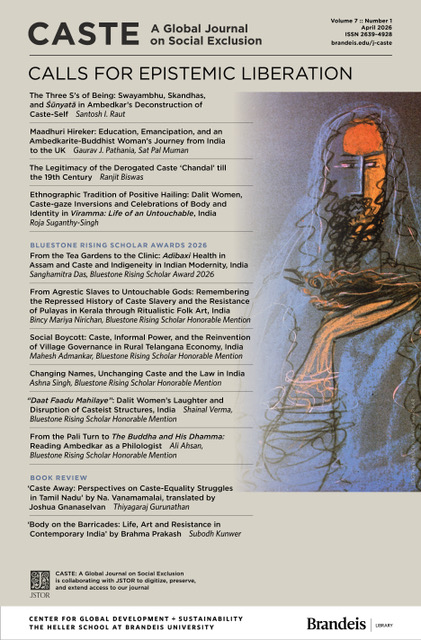
Ethnographic Tradition of Positive Hailing: Dalit Women, Caste-gaze Inversions and Celebrations of Body and Identity in Viramma: Life of an Untouchable, India
Article Sidebar
Main Article Content
Abstract
This article engages Viramma: Life of an Untouchable (1995), one of the earliest ethnographies to foreground a Dalit woman’s voice, marking thirty years since its publication. Viramma’s oral testimonies in this work continue to influence Dalit women by fostering positive body image, participatory knowledge production, and self-love. Ethnomusicologist Josiane Racine and anthropologist Jean-Luc Racine present Viramma’s life through affirmative stories that invert the caste-gaze that has traditionally cast Dalit women as passive victims marked for sexual violation. This article argues that through her narrative, Viramma inaugurates an ethnographic tradition of “positive hailing” calling attention to Dalit women’s embodied self-understanding and agency as vital to Dalit feminist ethnography. Her life stories enunciate Dalit women’s values, beliefs, and political agency, as countering both casteist and caste-neutral feminist frameworks, and redefining knowledge production as solidarity, healing and shared life. Viramma’s deliberate linguistic and narrative choices become acts of resistance that challenge casteist tropes attached to Dalit womanhood. In meticulously constructing her life narrative, Viramma establishes a tradition of self-chosen visibility that resists caste-imposed invisibility and stigma; she affirms Dalit female-focused ritual practices as necessary for life-sustenance.
Downloads
Article Details

This work is licensed under a Creative Commons Attribution 4.0 International License.
A. CORRESPONDING AUTHOR’S GRANT OF RIGHTS
The Corresponding Author grants to the Journal, during the full term of copyright and any extensions or renewals of that term, the following:
- An irrevocable non-exclusive right to reproduce, republish, transmit, sell, distribute, and otherwise use the Work in electronic and print editions of the Journal and in derivative works throughout the world, in all languages, and in all media now known or later developed.
- An irrevocable non-exclusive right to create and store electronic archival copies of the Work, including the right to deposit the Work in open access digital repositories.
- An irrevocable non-exclusive right to license others to reproduce, republish, transmit, and distribute the Work under the condition that the Authors are attributed. (Currently this is carried out by publishing the content under a Creative Commons Attribution 4.0 license.)
Copyright in the Work remains with the Authors.
B. CORRESPONDING AUTHOR’S DUTIES
- When distributing or re-publishing the Work, the Corresponding Author agrees to credit the Journal as the place of first publication.
- The Corresponding Author agrees to inform the Journal of any changes in contact information.
C. CORRESPONDING AUTHOR’S WARRANTY
The Corresponding Author represents and warrants that the Work is the Authors’ original work and that it does not violate or infringe the law or the rights of any third party and, specifically, that the Work contains no matter that is defamatory or that infringes any literary or proprietary rights, intellectual property rights, or any rights of privacy. The Corresponding Author also warrants that he or she has the full power to make this agreement, and if the Work was prepared jointly, the Corresponding Author agrees to inform the Authors of the terms of this Agreement and to obtain their written permission to sign on their behalf. The Corresponding Author agrees to hold the Journal harmless from any breach of the aforestated representations.
D. JOURNAL’S DUTIES
In consideration of the Author’s grant of rights, the Journal agrees to publish the Work, attributing the Work to the Authors.
E. ENTIRE AGREEMENT
This agreement reflects the entire understanding of the parties. This agreement may be amended only in writing by an addendum signed by the parties. Amendments are incorporated by reference to this agreement.