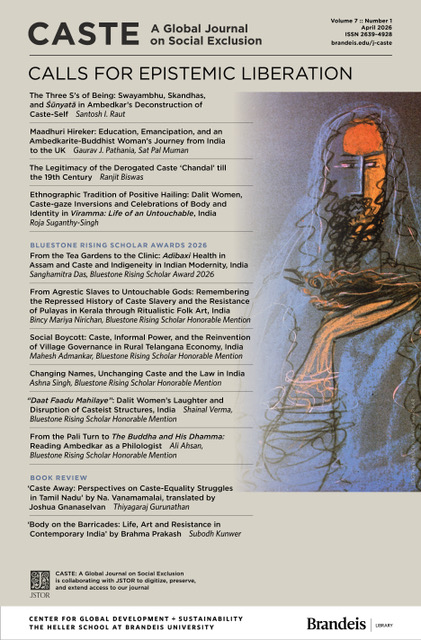
The Legitimacy of the Derogated Caste ‘Chandal’ till the 19th Century
Article Sidebar
Main Article Content
Abstract
This article explores the process of caste stigma and questions about its reliability. The Chandals were a social group primarily comprising the aboriginal peoples of the Indian subcontinent, later placed at the bottom of the Hindu caste system. In the case of Bengal, the first literary mention of Chandal is found in Charyapada, which is a Bengali-speaking community. Immediately later, two Puranas of Bengal were designated as Adham Shankara and Antyajas, along with the other lower castes. Through the ages, Mukundaram mentioned the occupational changes and their multitasking efficiency shifted their profession from cremation to salt and water chest-nut seller. The ethnographic evidence of the colonial times also provides information about their rituals, occupational efficiency, purity, and an increasing consciousness of social stigma, along with evictions. Exploring the ethnographic data, the article argues that modernity and environment-based ritual knowledge were at an extreme level. Following this tradition and derogatory perception of the upper castes, this article traces the position and legacy of the term Chandal, a lower caste in Bengal.
Downloads
Article Details

This work is licensed under a Creative Commons Attribution 4.0 International License.
A. CORRESPONDING AUTHOR’S GRANT OF RIGHTS
The Corresponding Author grants to the Journal, during the full term of copyright and any extensions or renewals of that term, the following:
- An irrevocable non-exclusive right to reproduce, republish, transmit, sell, distribute, and otherwise use the Work in electronic and print editions of the Journal and in derivative works throughout the world, in all languages, and in all media now known or later developed.
- An irrevocable non-exclusive right to create and store electronic archival copies of the Work, including the right to deposit the Work in open access digital repositories.
- An irrevocable non-exclusive right to license others to reproduce, republish, transmit, and distribute the Work under the condition that the Authors are attributed. (Currently this is carried out by publishing the content under a Creative Commons Attribution 4.0 license.)
Copyright in the Work remains with the Authors.
B. CORRESPONDING AUTHOR’S DUTIES
- When distributing or re-publishing the Work, the Corresponding Author agrees to credit the Journal as the place of first publication.
- The Corresponding Author agrees to inform the Journal of any changes in contact information.
C. CORRESPONDING AUTHOR’S WARRANTY
The Corresponding Author represents and warrants that the Work is the Authors’ original work and that it does not violate or infringe the law or the rights of any third party and, specifically, that the Work contains no matter that is defamatory or that infringes any literary or proprietary rights, intellectual property rights, or any rights of privacy. The Corresponding Author also warrants that he or she has the full power to make this agreement, and if the Work was prepared jointly, the Corresponding Author agrees to inform the Authors of the terms of this Agreement and to obtain their written permission to sign on their behalf. The Corresponding Author agrees to hold the Journal harmless from any breach of the aforestated representations.
D. JOURNAL’S DUTIES
In consideration of the Author’s grant of rights, the Journal agrees to publish the Work, attributing the Work to the Authors.
E. ENTIRE AGREEMENT
This agreement reflects the entire understanding of the parties. This agreement may be amended only in writing by an addendum signed by the parties. Amendments are incorporated by reference to this agreement.